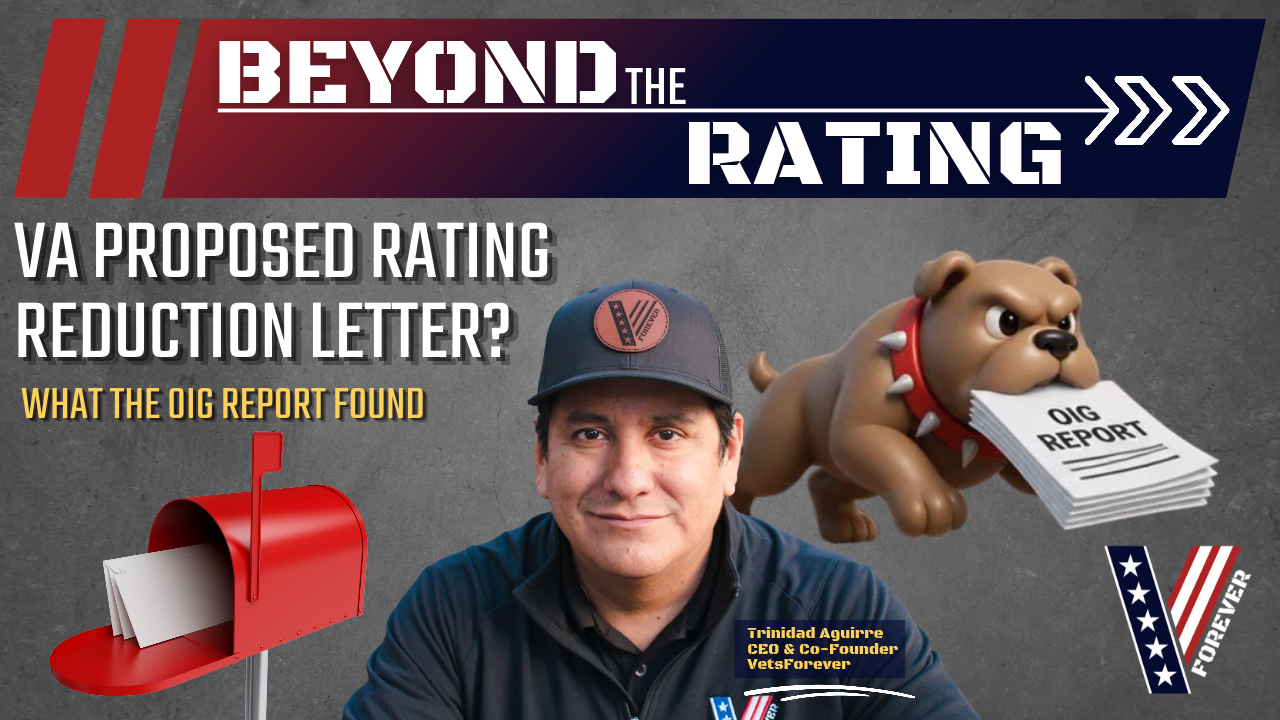
Federal law limits how and when the VA can reduce a disability rating, and the limits get stronger the longer a rating or service connection has already been in place. Three regulations govern it, 38 C.F.R. § 3.344, § 3.957, and § 3.951(b), known as the 5-year, 10-year, and 20-year rules. VetsForever breaks down what each one actually protects and what to do if a reduction letter shows up.
You’ve been rated at 70% for eleven years. The number hasn’t moved, your condition hasn’t gotten easier, and you stopped opening VA mail with any dread a long time ago. Then an envelope shows up with the words “proposed reduction,” and every bill tied to that check suddenly feels temporary again.
Trinidad Aguirre, CEO and Co-Founder of VetsForever, walks through the 5-year, 10-year, and 20-year rating protection rules on this episode of Beyond the Rating, the federal regulations that decide when the VA can and can’t touch a rating that’s already been in place for years.

What Is the 5-Year Rule for VA Disability Ratings?
Under 38 C.F.R. § 3.344, once a rating has been in place for five years or more, the VA can’t reduce it off a single good exam. It needs sustained, documented improvement: a pattern shown across more than one exam, under the ordinary conditions of daily life, the kind of evidence a single appointment can’t produce on its own.
If you have a decent day at a C&P exam and the examiner notes some improvement, that alone isn’t enough to support a reduction. The VA is still allowed to schedule reexaminations on a rating protected under this rule, and a re-exam notice by itself is not a reduction notice. But if you skip the exam, or walk in without preparing, that appointment can become the first data point in a reduction case. Knowing the difference between the two notices is most of what matters.
What Is the 10-Year Rule for VA Service Connection?
Once service connection has been in effect for ten years or more, 38 C.F.R. § 3.957 stops the VA from severing that connection outright, except for fraud or a showing that your service didn’t meet the character-of-discharge requirement. After ten years, the VA cannot go back and say your condition was never related to your service. That question is closed.
What this rule doesn’t do is protect the percentage. A veteran with ten years of protected service connection can still see their rating reduced, sometimes sharply. The connection stays; the number can still move. A veteran can be fully protected from severance under the 10-year rule and still get a reduction letter the same year.
What Is the 20-Year Rule for VA Disability Ratings?
38 C.F.R. § 3.951(b) sets a floor. Once a rating has been continuously at or above a given level for twenty years or more, the VA cannot reduce you below that level, short of fraud. If you’ve held 70% for two decades, 70% is where you stay at minimum. That floor is set by federal regulation, and the VA has no discretion to go below it.
Stack the 10-year and 20-year rules together and a veteran with two decades in the system is protected two ways at once: a locked service connection and a rating floor under it.
Why Does Your VA Effective Date Matter?
Every one of these clocks starts on your effective date, which is when your original claim was filed. It has nothing to do with when the VA got around to approving it. If it’s been more than five years since that date, the 5-year rule is already active. Past ten, the 10-year rule applies. Past twenty, you have a permanent floor. Veterans who filed years ago sometimes have one or more of these protections in force right now without realizing it.
What Should You Do If You Get a Proposed Reduction Letter?
38 C.F.R. § 3.105(e) spells out what you’re owed once a reduction is proposed but before anything is final. You get 60 days to submit evidence showing your rating should stay where it is, and a separate right to request a predetermination hearing within 30 days. Request that hearing on time and your payments continue at the current rate until a final decision is made. Miss both windows, and the proposed reduction becomes final.
If you’ve received a proposed reduction, the response window is short and the rules above have to be applied correctly to matter.
| VetsForever is a veteran-founded organization. We provide legal representation through VA-accredited representatives for VA disability claims, appeals, and military discharge upgrades. Our VA-accredited representative has direct VBMS access to your VA file. Serving veterans nationwide. |
VetsForever’s VA-accredited representatives know when the 5, 10, and 20-year protections apply to a given case and how to build a response around them. If you haven’t received a letter, a case review can still tell you exactly where you stand, how long your rating has been in place, which protections are already active, and what to watch for.
Got a reduction letter, or think one of these protections might already apply to your rating? A case review will tell you exactly where you stand. Get a case review
Watch the Conversation
Chapter Timestamps
0:00 — Intro: what the 5, 10, and 20-year rules protect
1:26 — The 5-Year Rule for VA Disability Ratings
2:19 — The 10-Year Rule for VA Service Connection
2:54 — The 20-Year Rule for VA Disability Ratings
3:51 — Why Your VA Effective Date Matters
4:23 — What to Do If You Get a Proposed Reduction Letter
5:30 — How VetsForever Can Serve
Frequently Asked Questions
If you request a predetermination hearing within the 30-day window, does that guarantee the reduction won’t happen?
No. Requesting the hearing on time keeps your payments at the current rate and gets you a chance to present your case in person, but the VA can still finalize the reduction afterward if the evidence presented doesn’t support keeping your rating where it is.
If your rating goes up after years at a lower level, does the 20-year floor move up to the new number?
Not automatically. Under 38 C.F.R. § 3.951(b), the floor is whichever level you’ve held continuously for 20 years or more. A higher rating you’ve only held for, say, five years, hasn’t earned its own 20-year floor yet. The VA could still reduce you back down to the older, lower level that’s actually been in place two decades.
Do the 5, 10, and 20-year rules protect your combined rating, or each condition separately?
Each one applies to a specific service-connected disability’s own rating or service connection. Your overall combined percentage isn’t what’s being measured. A veteran with multiple conditions could have one rating fully protected under the 20-year rule and another, more recently rated, condition with no protection yet at all.
Do you need a 100% rating for any of these protections to apply?
No. All three rules key off how long a rating or service connection has been in place. The percentage itself doesn’t factor into it. A 30% rating held for twenty years gets the same floor protection as a 100% rating held for twenty years.
Can the VA reduce your rating while a predetermination hearing request is pending?
No. Once you request the hearing within the 30-day window, your payments continue at the current rate until a final decision is issued. The reduction cannot take effect while that hearing is pending.
Does a scheduled reexamination mean the VA is reducing your rating?
No. A reexamination notice and a reduction notice are two different things. The VA can schedule a re-exam on a protected rating without proposing a reduction; the reduction process only starts if a separate proposed reduction letter goes out under 38 C.F.R. § 3.105(e).
What counts as “sustained improvement” under the 5-year rule?
Under 38 C.F.R. § 3.344, it means documented improvement shown across more than one exam, evaluated under the ordinary conditions of daily life, not just work or a single clinical setting. One good day at a C&P exam doesn’t meet that standard on its own.
Keep Reading on VetsForever
What GI Bill education benefits are available to veterans: the five VA education programs and how they compare. /what-gi-bill-education-benefits-are-available-to-veterans/
How to prepare for a complex VA disability claim: what to check in your file before you file. /how-to-prepare-for-a-complex-va-disability-claim/
You served your time to earn that rating. If the VA is trying to take it, get a VA-accredited representative in your corner. Get started
About VetsForever
VetsForever is a veteran-founded organization. We provide legal representation through VA-accredited representatives for VA disability claims, appeals, and military discharge upgrades. Our VA-accredited representatives have direct VBMS access to your VA file. Serving veterans nationwide. Not YouTube experts. Not unaccredited third parties. Real accredited representatives who served.