Everyone old enough to remember September 11th has a story about where they were. That’s part of what makes the day different from other history. It isn’t just something that happened. It’s something nearly every American still carries, specific down to the details, twenty-five years later.
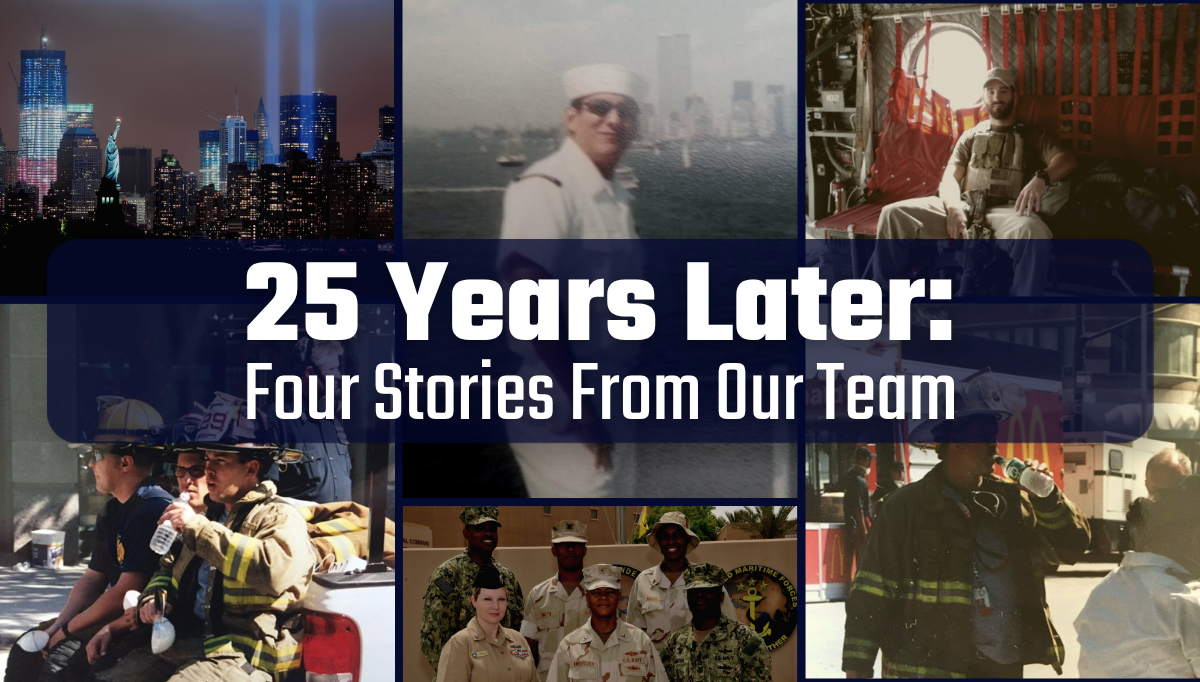
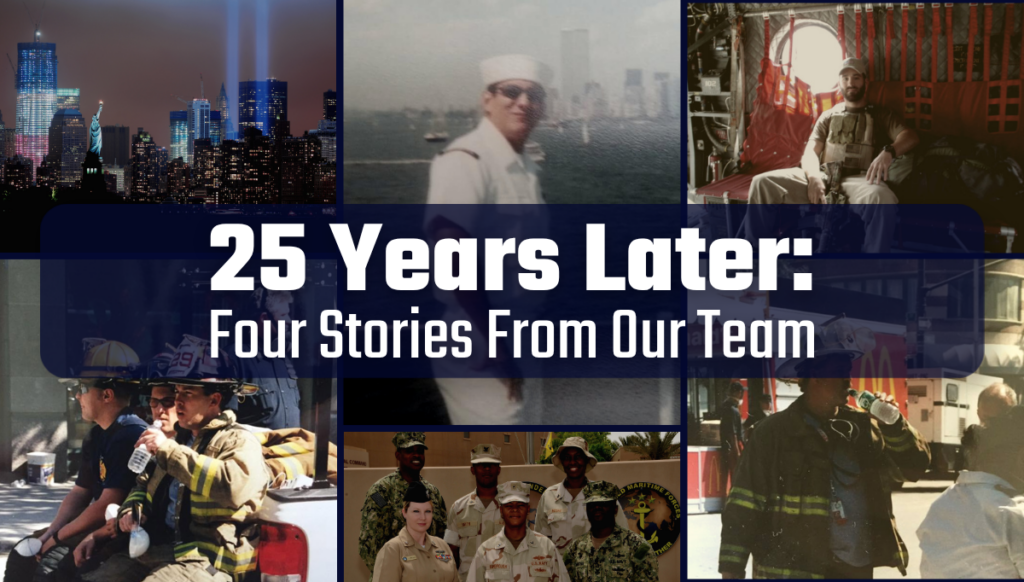
We asked four members of our team to share theirs. Two were already serving in the Navy that morning. A third was going through the enlistment process. The fourth has family ties to New York City that put her in the middle of it in a different way. None of these stories matter more than anyone else’s. They’re just one way of showing how far that morning reached, and how much it still shapes us today.
The petty officer whose enlistment was almost up
Chris Ward, our CRO and VetsForever co-founder, was teaching a class of about 25 students when a TV in the back of the room showed the first plane hit the World Trade Center. The room assumed it was an accident. Then the second plane hit.
At the time, he’d already submitted his paperwork to separate from the Navy. His enlistment was almost up.
A few weeks later, the Naval Special Warfare Development Group, DEVGRU, reached out and asked if he wanted to screen for orders. He didn’t know much about the command beyond the fact that it was a Navy SEAL unit. He said yes.
That decision turned into a 26-year career and nine deployments to Afghanistan, Iraq, and the Horn of Africa. He retired a Senior Chief Petty Officer.
“It changed the entire trajectory of my life,” he said. “I ended up seeing and doing things I never imagined for myself.”
At the time, the dominant feeling was anger, sharpened by the fact that the attack targeted civilians instead of a military installation. Twenty-six years gave him room to place that anger inside a larger picture, one that shaped an entire generation of service members.
“We felt a personal responsibility to step up and answer for those innocent lives lost, and we took that fight directly to the nation’s enemies,” he said. That’s how he describes the Pearl Harbor of his generation. Not history. A debt his generation of veterans set out to answer in person.
The sailor checking into a new assignment
Jimmy Burnside, one of our Senior Advocates, was an Aviation Electronics Technician First Class, checking into a new squadron, when he watched the second plane hit the World Trade Center on a television nearby. He remembers that image most clearly. It removed any doubt the country was under deliberate attack.
He was already serving, so 9/11 didn’t call him into the military. It reshaped the service he was already performing. Readiness took on an urgency that hadn’t existed the day before.
“Vigilance became more than a military requirement,” he said. “It became part of how I performed my duties and lived my daily life.”
His work aboard P-3 aircraft became part of a larger mission: protect the country, support the people serving beside him. That responsibility stayed with him for the rest of his time in uniform.
His message to a younger generation: 9/11 changed the direction of American lives in an instant, and kept shaping careers, deployments, and families for years after. Some of that cost was visible. A lot of it wasn’t.
Waiting on Long Island
Holly Griffeth, our VP of Marketing, never served in the military. September 11 is still deeply personal for her.
Her family is New York through and through. Her parents lived on the Lower West Side of Manhattan. Holly was on Long Island that morning, planning to head into the city later to stay with them.
She was on the phone with her dad about her plans for the evening. The Today Show played in the background, like it did in countless New York homes.
They saw the first plane hit while still on the phone. Their thoughts went straight to Holly’s mom. Her daily walk usually passed through the Wall Street area around that time.
They called her cell phone. No answer.
Calls weren’t going through. Everyone was trying to reach someone. Holly and her dad had no idea if her mom was safe.
They waited nearly five hours.
Her parents were reunited after the North Tower fell. Her mom was safe, but she’d watched the towers come down from a few blocks away and been caught in the chaos of thousands fleeing Lower Manhattan.
Once Holly knew her mom was safe, the question became: what can we do?
Three days later, Holly got into Manhattan. For the next month, she volunteered with her parents, delivering meals and washing clothes for Ground Zero workers.
She remembers the fear and uncertainty of that day. But she remembers what came after it too. People volunteered. They donated, checked on neighbors, and supported first responders, military members, and complete strangers. American flags seemed to appear everywhere. There was a shared patriotism she hasn’t seen since.
Twenty-five years later, that’s still one of the things she remembers most: not just the fear, but how people showed up for each other afterward.
Seventeen years old, waiting on his Navy medical screening
Keithan Smith, our Director of Strategic Operations, wasn’t in the military yet on September 11th. He was 17, a senior in high school, waiting on his medical screening at a Military Entrance Processing Station to enlist in the Navy.
He remembers the uncertainty most, looking to the adults around him for answers and watching them try to process what was happening in real time, same as everyone else. After the second plane hit, the station was evacuated.
His recruiter told him he’d understand completely if he wanted to walk away from joining the Navy. Keithan took three days, then went back and finished enlisting.
“It didn’t make me walk into MEPS,” he said, “but after everything that happened, it didn’t make me walk away either.”
His first duty station was the National Security Agency. Later, his work took him into the Pentagon, into the section damaged by Flight 77. At Camp H.M. Smith in Hawaii, he served surrounded by the history of Pearl Harbor. Eventually he became a Navy recruiter himself, walking young people through the same MEPS doors he’d walked through at 17. Bahrain. The Joint Chiefs of Staff. A Navy warship.
“I walked into MEPS as one of the kids looking to the adults for answers,” Keithan said. “Eventually, I became one of the adults responsible for the people coming behind me.”
Twenty-five years later
No one in the world knew that morning how much September 11 would shape the years ahead. For some, it changed the course of a military career. For others, it changed what serving meant: not just a uniform, but showing up to volunteer, caring for the people around them, carrying that sense of patriotism forward. Families across the country carried a day they’d never be able to talk about without remembering exactly where they were standing and who they were worried about.
Twenty-five years later, the details are still there.
Everyone had someone they were worried about that morning. But the story of that day was always bigger than any one person’s worry, or any one family’s.
These are four stories from our team. There are millions more, from veterans, first responders, families, and Americans who lived that day in their own way.
We remember those who lost their lives. Those who ran toward the danger. Those who served in the years that followed. The families who carried the weight of it with them.
And we remember something harder to put into words: how Americans showed up for each other afterward.
We remember. We’re grateful. Never forget.