
| A veteran’s state can add property tax exemptions, income tax breaks, education benefits for dependents, and housing assistance on top of federal VA compensation, and these benefits vary widely by state, are not automatic, and usually require a separate application. States like Texas, Florida, Virginia, Alaska, and Illinois currently rank among the most veteran-friendly. Newer state laws in California and South Carolina also protect veterans from unaccredited operators who charge illegal fees for claims help. |
Does Your State Have Your Back? What Veterans Are Owed Beyond the VA Check
Your state can add property tax exemptions, income tax breaks, education benefits for your dependents, and housing assistance on top of your federal VA compensation. These benefits vary widely by state, they’re not automatic, and most require a separate application. Texas, Florida, Virginia, Alaska, and Illinois currently rank among the most veteran-friendly states. New laws in California and South Carolina also protect you from unaccredited operators who charge illegal fees for claims assistance.
You file the federal claim, get the rating letter, and call the paperwork finished. The property tax bill still shows up every spring, full amount, no exemption applied, because nobody ever told you the county had a box for that. You pay it anyway, for years, the same way you file the same 1040 every April without knowing your state might not tax your disability compensation at all. None of that is your fault. Nobody handed you the list.
Watch the Conversation
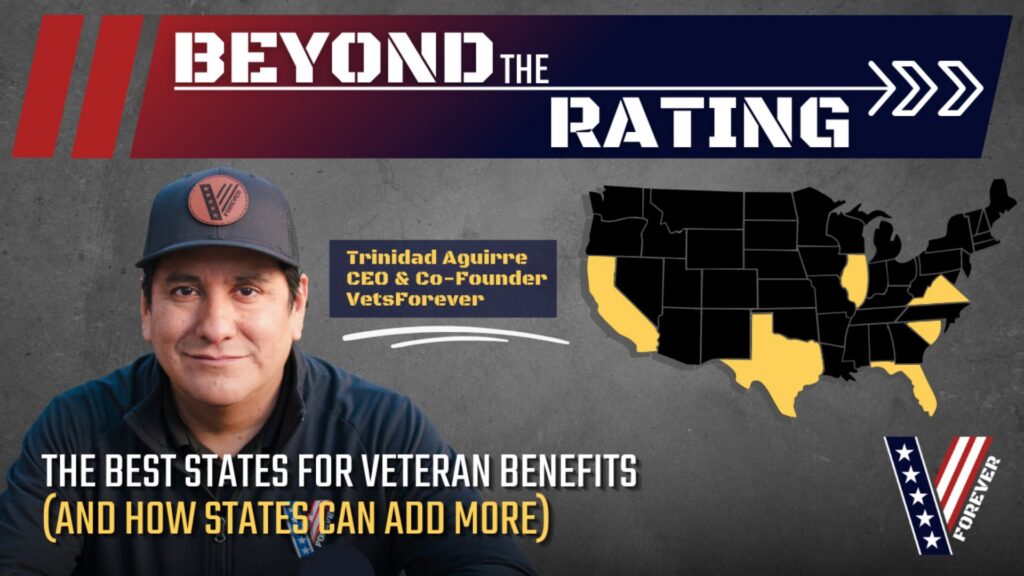
Beyond the Rating | The Best States for Veteran Benefits (And How States Can Add More)
Trinidad Aguirre, Navy veteran and CEO and co-founder of VetsForever, hosts this solo episode on what state governments offer veterans that has nothing to do with a VA rating decision.he list.
Trinidad Aguirre, Navy veteran and CEO and co-founder of VetsForever, hosts this solo episode on what state governments offer veterans that has nothing to do with a VA rating decision.
Chapters
- 00:00 Intro
- 00:55 What State Benefits Actually Cover
- 02:21 Examples From States with Strong Benefits
- 03:35 Examples of States Protecting Veterans
- 04:05 Why You Should Care
- 05:02 How VetsForever Can Help
- 05:28 In Closing
What State Benefits Actually Cover
Federal compensation is the floor. What your state stacks on top of that floor runs on its own rules and its own deadlines, and the gap between states is real. Depending on where you live, this can include:
- State income tax exemptions on military retirement pay, VA disability compensation, or both
- Property tax exemptions, in some states a full waiver above a certain disability rating
- Tuition waivers, scholarships, and in-state tuition rates for you and your dependents
- Hiring preferences for state government jobs and licensing reciprocity for military-trained skills
- Down payment assistance, state-run veterans homes, and assisted living options
- Financial and legal assistance, transportation, and burial benefits
You’ve probably never looked this list up, not because you weren’t paying attention, but because nobody told you it existed.
VetsForever is a veteran-founded organization.
We provide legal representation through VA-accredited representatives for VA disability claims, appeals, and military discharge upgrades. Our VA-accredited representative has direct VBMS access to your VA file. Serving veterans nationwide.
Which States Currently Lead, and What They Offer
Texas, Florida, Virginia, Alaska, and Illinois consistently rank among the strongest for state-level veteran benefits.
Texas runs the Hazlewood Act: 150 hours of tuition-free study at public colleges, transferable to a spouse or dependent child, plus low-interest home and land loans through the Veterans Land Board.
Florida offers property tax exemptions that scale starting at a 10% disability rating, along with tuition waivers for veterans and dependents at public colleges.
Virginia provides property tax exemptions and in-state tuition for veterans and dependents regardless of how long they’ve lived in the state.
Alaska offers up to a $150,000 property value exemption for veterans rated 50% or higher, plus education waivers.
Illinois covers tuition and fees at public colleges through the Illinois Veterans Grant, and gives a full property tax exemption on a primary residence to veterans rated 100% disabled.
Other states offer less, and neighboring states rarely match each other. Benefits, caps, and income limits change year to year. Check your state directly, and treat any figure here as a starting point, not the final word.
What New State Laws Protect Veterans From
States are also cracking down on a specific problem: unaccredited operators charging you illegal or excessive fees to file your VA claim. California’s SB 694, signed by Governor Newsom, and South Carolina’s Safeguarding American Veterans’ Benefits Act both target this directly, restricting who can charge a fee for claims assistance and what they’re allowed to charge.
No one can legally charge you a fee to file your first VA claim.
These laws exist because veterans were being charged for something federal law already prohibits. Under 38 U.S.C. § 5904(c)(1), no one can charge you a fee for work on an original claim before VA issues its first decision. Knowing that protection exists is just as much a part of your state’s veteran benefits picture as its tax and education programs.
Why This Matters
State benefit programs aren’t fixed once and done. A state that passes strong veteran legislation this year may add something next year that didn’t exist before. A state that lets a program lapse takes something away just as quietly. State governments decide who qualifies, when, and how much, and every legislative session can add to or take from that list.
You could go years without knowing your state offers a full property tax exemption, or that your kids qualify for in-state tuition at no cost, simply because nobody mentioned it.
None of it applies itself.
Whether your state has your back comes down to one thing: whether you go and get what’s already being offered.
Frequently Asked Questions
Are state veteran benefits automatic once I have a VA disability rating?
No. You’ll need to apply separately through a state or county office for nearly every state-level benefit, including property tax exemptions. Your VA rating decision doesn’t trigger a state benefit on its own.
What happens to my state benefits if I move to a different state?
Nothing transfers automatically. A property tax exemption approved in one state means nothing to your new state’s tax assessor, and you’ll typically have to reapply for every state-specific benefit after you establish residency somewhere new. Federal eligibility is the one thing that does carry over: a 100% rating is a 100% rating everywhere. It’s the state-level paperwork that resets.
Will using state veteran benefits reduce my federal VA compensation?
No. State and federal benefits run on entirely separate systems. A property tax exemption, an education waiver, or a state income tax break won’t touch what VA pays you monthly.
What should I do if someone offers to file my claim for a fee before VA has made a decision?
Confirm they’re VA-accredited before you pay anything. Under 38 U.S.C. § 5904(c)(1), no one can charge you a fee for work on an original claim before VA issues its first decision, and California and South Carolina have both recently passed laws specifically penalizing unaccredited operators who charge veterans anyway.
Where do I find my state’s veteran benefits list?
Most state departments of veterans affairs publish their own veteran benefits list directly on their official site. Search your state’s site directly rather than relying on secondhand summaries.
Do all 50 states offer veteran benefits beyond VA compensation?
Every state offers something, but the specifics differ widely. Some offer full property tax exemptions and tuition-free college for veterans and dependents. Others offer far less. Check your state’s department of veterans affairs site for its full list.
Both Sides of Your Claim, Covered
Our VA-accredited representative handles the federal side of your claim. Our team also identifies which state programs apply to your situation. Schedule a case review with one of our Advocates here.