The thing that connects every generation of American veterans is the honor and loyalty carried by the people who raise their hand. It has not changed since 1776. The uniforms changed. The wars changed. The technology changed. That inner sense of duty in the people who serve did not.
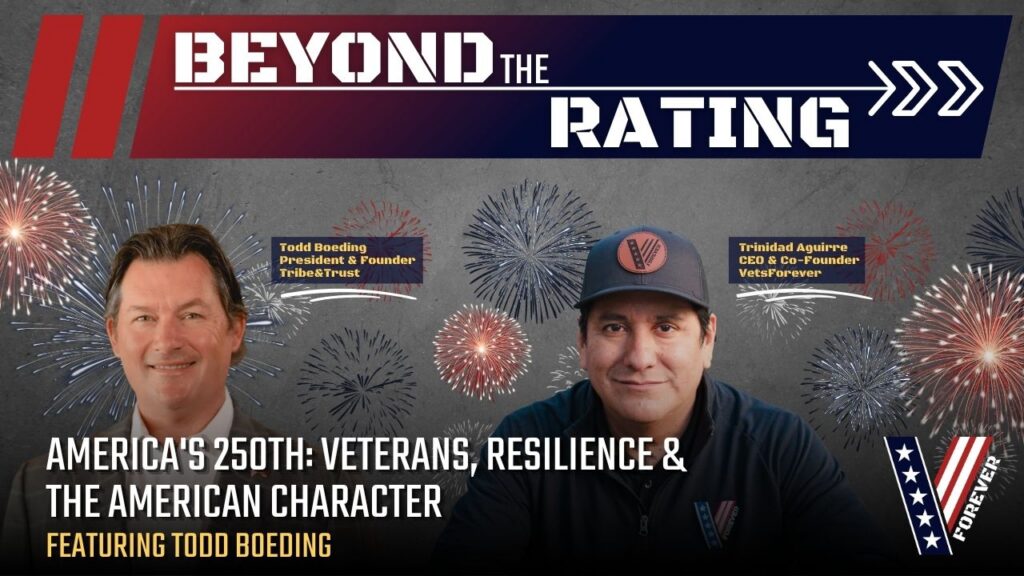
That is the question at the center of the newest episode of Beyond the Rating, the VetsForever podcast. Host Trinidad Aguirre, a U.S. Navy veteran and co-founder of VetsForever, sat down with Todd Boeding, a Marine Corps Major who commanded the Silent Drill Platoon and served at the White House. Two veterans, two very different careers, one honest conversation about what 250 years of American service actually adds up to.
Here is what they got into, and why it matters as the country marks its 250th birthday.
American veterans by the numbers
- Roughly 18 million living veterans are in the United States today, about 6% of the adult population.
- Close to 8 million World War II veterans used the original 1944 GI Bill for education or training in its first years. It helped build the postwar middle class.
- About 5.5 million veterans live with a service-connected disability today.
- Of the roughly 16 million Americans who served in World War II, fewer than 1% are still with us. The generation that fought the war is nearly gone.
Sources: U.S. Department of Veterans Affairs, Pew Research Center, U.S. National Archives.
When is America’s 250th anniversary?
America’s 250th anniversary is July 4, 2026. It marks 250 years since the signing of the Declaration of Independence in 1776. Some call it the Semiquincentennial. Expect parades, fireworks, and speeches across the country.
To mark the country’s 250th birthday runs through America250, a nonpartisan initiative working to get every American involved in the commemoration. It brings together the U.S. Semiquincentennial Commission, which Congress established in 2016, and the nonprofit America250.org that backs it. The effort runs through July 4, 2026, and the goal is straightforward: look back at where the country has been, honor the people who built it, and think about what we hand to the next generation. Former Presidents George W. Bush and Barack Obama, along with former First Ladies Laura Bush and Michelle Obama, serve as Honorary National Co-Chairs. More than 350 members of Congress back it through a bipartisan caucus, the largest in U.S. history.
The anniversary is a good reason to celebrate. It is also a good reason to ask a harder question: over those 250 years, how has America actually treated the people who did the serving? That is the question this episode chases down.
Has America gotten better at treating its veterans?
The honest answer is yes and no. The country has gotten better in some real ways and slower in others.
First, the high points are worth naming. The GI Bill after World War II sent a generation of veterans to college and helped build the middle class. That was the country keeping a promise.
But the low points are just as real. The Bonus Army of 1932 saw World War I veterans camp in Washington asking for pay they were owed, and the very military they once served in ran them out. Vietnam veterans came home to silence, and worse. Those chapters are part of the 250-year story too.
Today the country says “thank you for your service” a lot. Whether that gratitude turns into action, or just stays a phrase, is the real test. Trinidad puts it plainly in the episode: public opinion has improved, but saying the right words and doing the right thing are two different jobs.
250 years, in five moments
The story of how America treats its veterans is not a straight climb. Here are five moments that show the swings.
- 1776 — The debt begins. The Continental Congress promised pensions to soldiers of the Revolution. Following through took decades, and many never saw a dime. The pattern of promising first and paying later starts here.
- 1932 — The Bonus Army. World War I veterans marched on Washington to collect service pay they were owed. The Army cleared them out by force. A low point, and a warning about what neglect looks like.
- 1944 — The GI Bill. Signed weeks after D-Day, it put college and home ownership within reach of millions of returning veterans. The country kept a promise, and the payoff shaped a generation.
- 1970s — Vietnam homecomings. Veterans came home to a divided country and, too often, silence. The service was real. The welcome was not. Much of today’s “thank you for your service” reflex traces back to making up for this.
- 2026 — America 250. The country turns 250 with more resources for veterans than ever and a claims system that still leaves people behind. Better than 1932. Not yet finished.
Why does America 250 matter to veterans specifically?
It matters because people who served paid for the 250 years the country is celebrating. Every anniversary the country marks sits on top of that. The fireworks are the easy part. The debt is the part that stays.
So for veterans watching, the anniversary is a chance to place your own service in a much longer line. Whether you served in 1975 or 2015, you are part of the same 250-year thread. That is not a small thing. It is worth sitting with.
Who is Todd Boeding?
Todd Boeding is a retired Marine Corps Major and the founder of Tribe & Trust. He enlisted in 1989, earned his commission, and commanded the Marine Corps Silent Drill Platoon, one of the most precision-demanding assignments in the military. He served at the White House and separated in 2003.
After the uniform came off, Boeding spent two decades in corporate leadership and gave more than twelve years to Carry The Load, including a run hosting its podcast and years on its board. He now runs Tribe & Trust, where he teaches people what the Marine Corps taught him about leadership and trust.
“At the end of the day, leaders are not born. Leaders are made.” — Todd Boeding
What do civilians get wrong about veterans?
Boeding spent 20 years in corporate America after the Corps, which means he has spent 20 years correcting the same few assumptions in boardrooms and hiring meetings. A few he runs into most:
- That veterans are fragile. The assumption shows up as tiptoeing. Most veterans want to be treated like the capable adults they are, not handled with care.
- That military experience does not translate. A platoon commander has managed people, budgets, logistics, and pressure that most managers never touch. The skills transfer. The résumé just needs a translator.
- That every veteran has a war story, and you should ask about it. Some do. Many do not want to. Let them bring it up.
For a civilian reader, this is the part worth carrying into your next conversation with a veteran coworker or neighbor. Treat them as the leader they were trained to be.
Who is Trinidad Aguirre?
Trinidad Aguirre is a U.S. Navy veteran, rated 100% permanently and totally disabled, and the co-founder and CEO of VetsForever. He built the organization after the VA system failed him personally, so the same thing would stop happening to other veterans.
Before VetsForever, Aguirre spent 20 years in business strategy and marketing across companies like Verizon and CBRE. He holds an MBA from the University of Dallas. In 2026, the D’Aniello Institute for Veterans and Military Families named him to its CEO circle Cohort. When he talks about the VA claims process, he is not talking theory. He lived it.
What is Beyond the Rating?
Beyond the Rating is the VetsForever podcast built for veterans who want straight answers. No scare tactics. No hype. Real conversations with people worth listening to. Trinidad hosts, and the show covers VA claims, veteran benefits, leadership, and the questions veterans actually ask.
What is one thing you can do this week?
The episode ends on a simple challenge: do one concrete thing, not just feel something. Here are three, split so a veteran and a civilian each find one that fits.
- Walk, give, or show up. Join a Carry The Load walk, volunteer with a local veteran group, or attend a military community connected event or Veterans Day event with intent instead of habit.
- Check on someone. Reach out to one veteran you know and ask a real question. Not “thanks for your service.” Something like “how did your transition actually go?”
- Learn how the VA system works. Even a basic understanding of claims and appeals means you can point a veteran in the right direction when it counts. That knowledge is its own kind of service.
For veterans, that one thing might be your own claim. If you wore the uniform and the VA has not done right by you, you do not have to sort it out alone.
Watch the full episode
The full conversation between Trinidad Aguirre and Todd Boeding is available now on YouTube.
Todd tells people in the episode to go watch the Silent Drill Platoon. He is right. If you have never seen the unit he commanded, search “Marine Corps Silent Drill Platoon” and watch one performance. Rifles, bayonets, no commands called. It lands better than any description.
Keep going
More from Beyond the Rating and VetsForever:
- More episodes of Beyond the Rating — honest conversations for veterans, new episodes weekly.
- Military discharge upgrades: how they work — what a discharge upgrade is and who qualifies.
- Understanding VA disability claims and appeals — a plain-language starting point.
About VetsForever
VetsForever is veteran-founded and veteran-run. We provide legal representation through VA-accredited representatives, and we help veterans with VA disability claims, appeals, and military discharge upgrades nationwide. Not YouTube experts. Not unaccredited claim sharks. Real accredited advocates who served.
Frequently Asked Questions
When is America’s 250th anniversary? America’s 250th anniversary is July 4, 2026, marking 250 years since the Declaration of Independence in 1776. Some call it the Semiquincentennial.
What is the America 250 episode of Beyond the Rating about? The episode traces 250 years of how America has treated its veterans and asks whether the country is truly doing better or just getting better at saying the right things. Trinidad Aguirre and Marine Corps Major Todd Boeding discuss public opinion, military service across generations, and what we owe the next generation.
Who is Todd Boeding? Todd Boeding is a retired Marine Corps Major who commanded the Silent Drill Platoon and served at the White House. He founded Tribe & Trust and spent more than a decade with Carry The Load.
Who hosts Beyond the Rating? The podcast is hosted by Trinidad Aguirre, a U.S. Navy veteran rated 100% permanently and totally disabled and the co-founder and CEO of VetsForever.
Does VetsForever help with VA claims? Yes. VetsForever provides legal representation through VA-accredited representatives and helps veterans with disability claims, appeals, and military discharge upgrades nationwide.
How many veterans are in the United States? Roughly 18 million living veterans are in the United States today, about 6% of the adult population, according to the VA and Pew Research Center.
What do civilians most often get wrong about veterans? Common assumptions are that veterans are fragile, that military experience does not translate to civilian jobs, and that every veteran wants to talk about combat. Military service builds real leadership, management, and problem-solving skills, and many veterans prefer to be treated like the capable professionals they are.
How do I get started with VetsForever? Visit VetsForever.com and request a case review. If you served and the VA has not done right by you, that is the place to start.