The envelope waits on the kitchen counter for two days before you open it. Inside, one sentence carries the whole decision: the evidence does not establish service connection. You mailed in a private doctor’s letter, a statement from someone who watched you struggle, and your own account of the injury. VA sent an examiner who saw you once. You read the page again, looking for the line that explains why your side counted for less, and there is no such line. A rule exists for exactly that moment.
VA must decide an issue in your favor when the positive and negative evidence on it is in approximate balance (38 U.S.C. § 5107(b)). VA’s own regulation calls that a reasonable doubt: one left standing after VA weighs the whole file, with the evidence neither proving nor disproving the claim (38 C.F.R. § 3.102).
On Beyond the Rating, Trinidad Aguirre, a Navy veteran and the CEO of VetsForever, takes this episode solo to cover the rule and what happens when VA misses it.
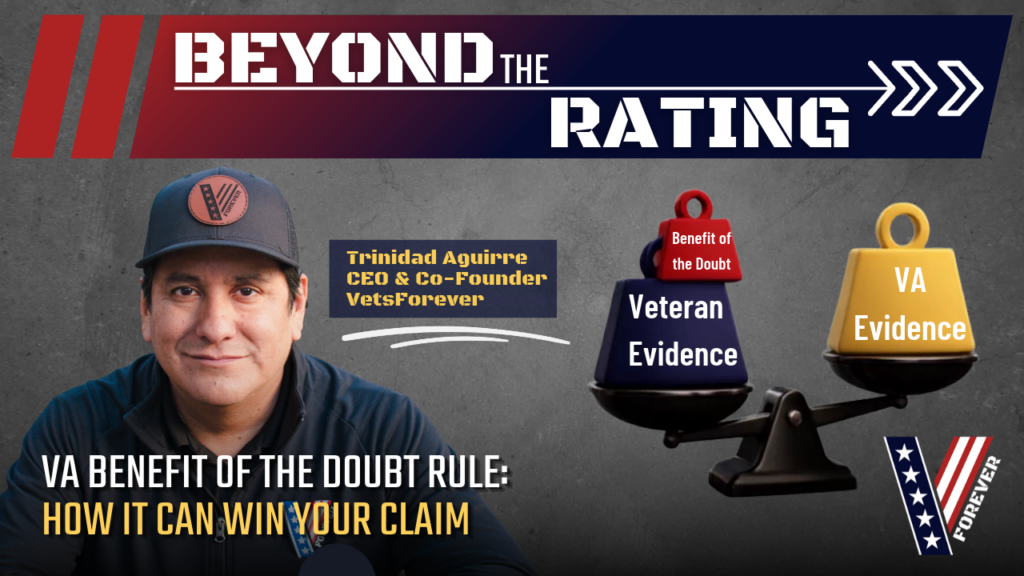
Watch: Beyond the Rating | VA Benefit of the Doubt Rule: How It Can Win Your Claim
Chapters:
- 00:00 Intro
- 00:44 The Benefit of the Doubt Rule
- 01:16 The Benefit of the Doubt Rule Explained
- 02:14 What Equipoise Means & What the Standard Veteran Must Meet
- 03:34 Application of the Rule in VA Claims
- 04:50 Triggering the Benefit of the Doubt Rule
- 06:00 Consequences of the VA’s Failure to Apply the Rule
- 07:24 Key Takeaways & Conclusion
What kind of doubt does the rule cover?
A real one. The doubt has to be substantial and within the range of probability, and speculation or a remote possibility does not qualify (38 C.F.R. § 3.102). Inside that limit the law is on your side: the Secretary shall give the benefit of the doubt to the claimant (38 U.S.C. § 5107(b)).
Trinidad’s shorthand is the baseball one. The tie goes to the veteran.
What does approximate balance mean?
Go back to the kitchen counter. A private doctor says your condition traces to service, and the VA examiner says it does not. The conflict is where the weighing starts. Reasonable doubt cannot reconcile an actual conflict in the evidence (38 C.F.R. § 3.102). VA weighs the two opinions against each other first.
Two outcomes follow. If VA finds one opinion more persuasive, the file is out of balance and the rule does not apply. If both opinions rest on the same records, explain their reasoning, and land in different places, with nothing in the file to favor one over the other, that is a tie, and the tie goes to you.
The Federal Circuit set this test in Lynch v. McDonough, 21 F.4th 776 (Fed. Cir. 2021) (en banc). The rule applies whenever the competing evidence is in approximate balance, a range that reaches past exact equipoise. It stays out of play when the evidence persuasively favors one side. Exact equipoise falls at the center of that range, and you do not have to bury VA in records to reach it.
Which parts of your claim does the rule reach?
The rule works issue by issue. Whether the event happened, whether it caused your condition, what rating it earns, when it started: each is its own question, and the rule applies to each.
The statute reaches any issue material to the decision, and the regulation adds service origin, the degree of disability, and any other point (38 U.S.C. § 5107(b); 38 C.F.R. § 3.102). A close call on one question does not settle the next.
What triggers the rule?
Nothing activates it until evidence is in the file. The responsibility to present and support your claim is yours (38 U.S.C. § 5107(a)), and an assertion with no evidence behind it gives VA nothing to weigh against the negative evidence.
Trinidad says the bar is lower than most veterans think, and he names three kinds of evidence that can bring a file to rough balance: your own consistent, credible lay statement; a statement from a spouse or fellow service member who saw the condition firsthand; and a medical opinion that links the condition to service. Any of them can do it, alone or combined.
Picture your spouse writing down the week in March you could not get out of bed. That is a dated fact, and VA can weigh a dated fact. A well-written personal statement may fall short of winning the claim and still pull the file close enough to even.
What happens when VA does not apply the rule?
A decision has to show its work. The Board must state the reasons or bases for its findings on all material issues (38 U.S.C. § 7104(d)(1)). A denial that never says how your evidence was weighed is a point you can raise. So is one that passes over a lay statement without a word, or states a conclusion without looking at the balance of the record. Trinidad calls this a reversible error.
The review option that fits depends on what you have. If the evidence is already in your file and the decision ignored it, a Higher-Level Review has a reviewer look at that question: whether an error or a difference of opinion changes the decision. It takes no new evidence, and according to VA.gov the request is due within one year of the decision. New and relevant evidence calls for a Supplemental Claim. A Board Appeal sends the case to a Veterans Law Judge.
Where VetsForever fits in
If a denial reached you with no account of how VA weighed your evidence, a VetsForever case review compares that decision with the record VA had when it decided. If you are working on a claim or an appeal right now, you can request one at vetsforever.com.
Frequently Asked Questions
What if your symptoms fall between two rating levels?
VA assigns the higher rating when the disability picture more nearly approximates its criteria, and the lower one otherwise (38 C.F.R. § 4.7). Where reasonable doubt remains about the degree of disability, 38 C.F.R. § 4.3 resolves it in your favor. Take a condition that could land at 30 or 50 percent with no clear answer on which fits. Evidence that matches the rating criteria for your condition, such as how often your symptoms occur and what they do to your work, shows which level fits.
Do you have to ask VA to apply the benefit of the doubt rule?
The duty is VA’s. The statute directs the Secretary to consider all information and lay and medical evidence of record and to give the benefit of the doubt when the evidence is in approximate balance (38 U.S.C. § 5107(b)). Nothing in that sentence makes the duty depend on a request.
What if your service records are missing?
A missing record does not close the claim. The doctrine applies without official records, particularly for an event that arose in combat or similarly strenuous conditions and fits the probable results of those hardships (38 C.F.R. § 3.102). Your account and statements from people who were there become the evidence VA weighs.
Can VA deny your claim because it doubts your account?
VA needs more than a hunch to withhold the doctrine. The regulation separates mere suspicion about a statement from impeachment or contradiction by evidence or known facts, and only the second can count against you when the rest of the record supports applying the doctrine (38 C.F.R. § 3.102). A treatment note that conflicts with your statement is the second kind.
Can a court review whether VA got the balance right?
Only within limits. In Bufkin v. Collins, 604 U.S. 369 (2025), the Supreme Court held that the Veterans Court reviews VA’s finding on approximate balance for clear error. The Court treated that finding as predominantly factual. Legal conclusions, such as whether VA applied the wrong standard, are reviewed de novo.
VetsForever is a veteran-founded organization. We provide legal representation through VA-accredited representatives for VA disability claims, appeals, and military discharge upgrades. Our VA-accredited representative has direct VBMS access to your VA file. Serving veterans nationwide.