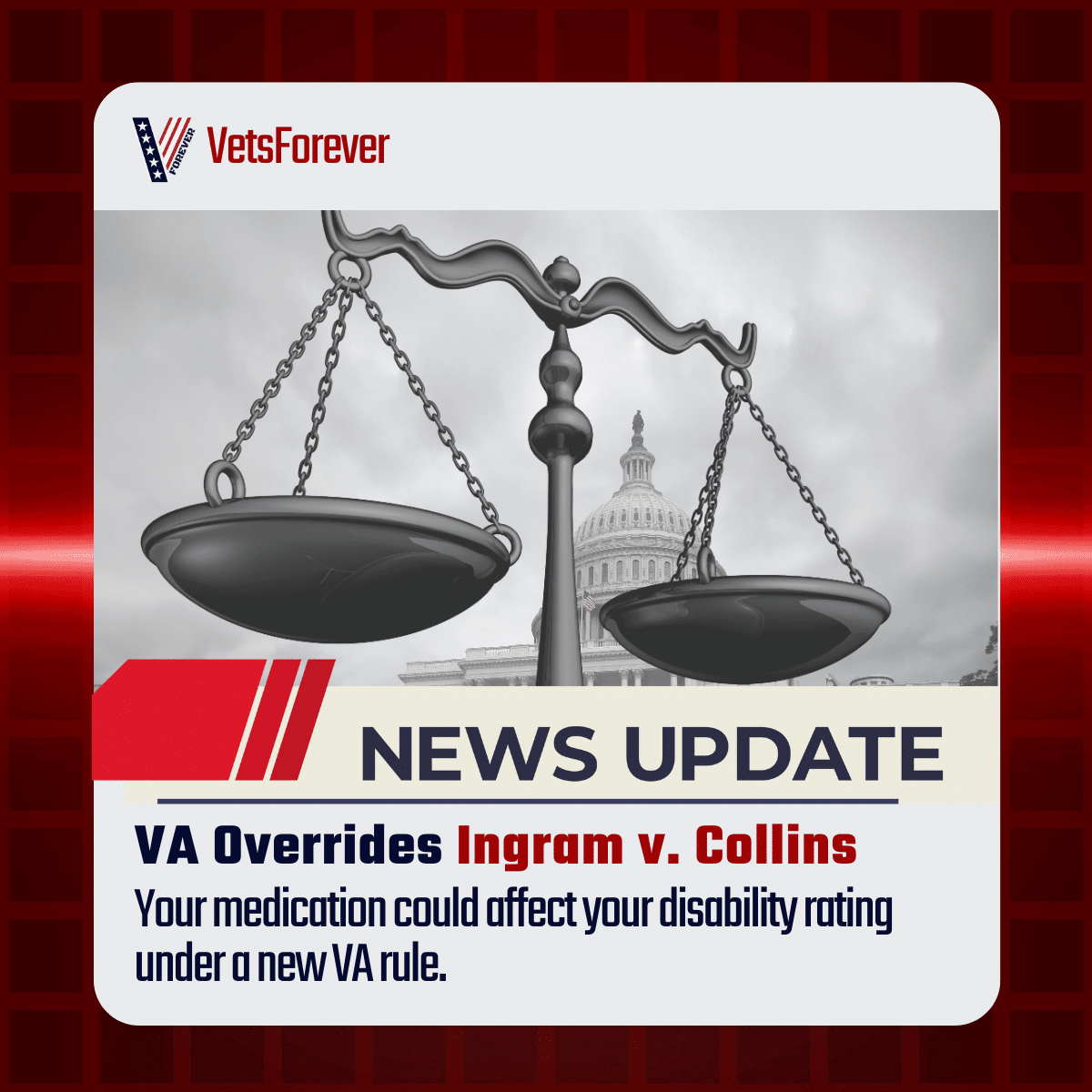
Recent headlines and social media conversations have sparked concern across the veteran community about the impact of the VA’s updated medication guidance on disability ratings. Much of the discussion has centered on how newer interpretations are often framed through comparisons like Ingram vs. Collins could reshape how claims are evaluated.
Before reacting to speculation, it is critical to understand what has actually changed, what has not, and where veterans can turn for trusted guidance when questions arise.
No, the VA Is Not Automatically Stripping Existing Benefits
First and foremost, the directive does not automatically strip veterans of existing disability benefits.
It also does not require the VA to reopen previously granted claims on its own. At this stage, there is no broad mandate forcing regional offices to re-adjudicate old awards without a triggering event such as:
- A new claim
- A request for increase
- A routine future exam
- Evidence of improvement
What the directive may influence, however, is how certain claims are evaluated going forward. Depending on how regional offices apply the guidance in practice, some benefits could become more difficult to obtain.
That distinction matters. Policy interpretation affects future adjudication standards far more than it does locked-in historical ratings.
Don’t Make Reactive Decisions Based on Headlines
Veterans should not withdraw a pending claim, abandon an appeal, or rush into filing a new claim based solely on social media interpretations or news headlines.
Before making any decision that could impact your benefits, speak with the VA-accredited attorney at VetsForever who can evaluate your specific situation.
If you have concerns about how this directive may affect veterans broadly, consider submitting formal comments to the VA during the current 60-day comment period: https://www.regulations.gov/
Veteran voices matter, and informed engagement often shapes how policy is implemented in the real world.
Where VetsForever Can Help
As regulatory guidance evolves, confusion often follows. That is where organizations like VetsForever play an important role.
VetsForever has a VA-accredited attorney who is federally authorized to represent veterans before the Department of Veterans Affairs. Accreditation matters because it allows representatives to:
- Access veterans’ VA claims files through VBMS
- Review C&P exam results
- Submit legal arguments and evidence
- File appeals directly with the VA
- Challenge inadequate exams or decisions
This level of representation goes far beyond general “coaching” or template-driven claims assistance.
When policy shifts—like the medication directive—accredited representation becomes even more critical because claims strategy must adapt to new evidentiary standards.
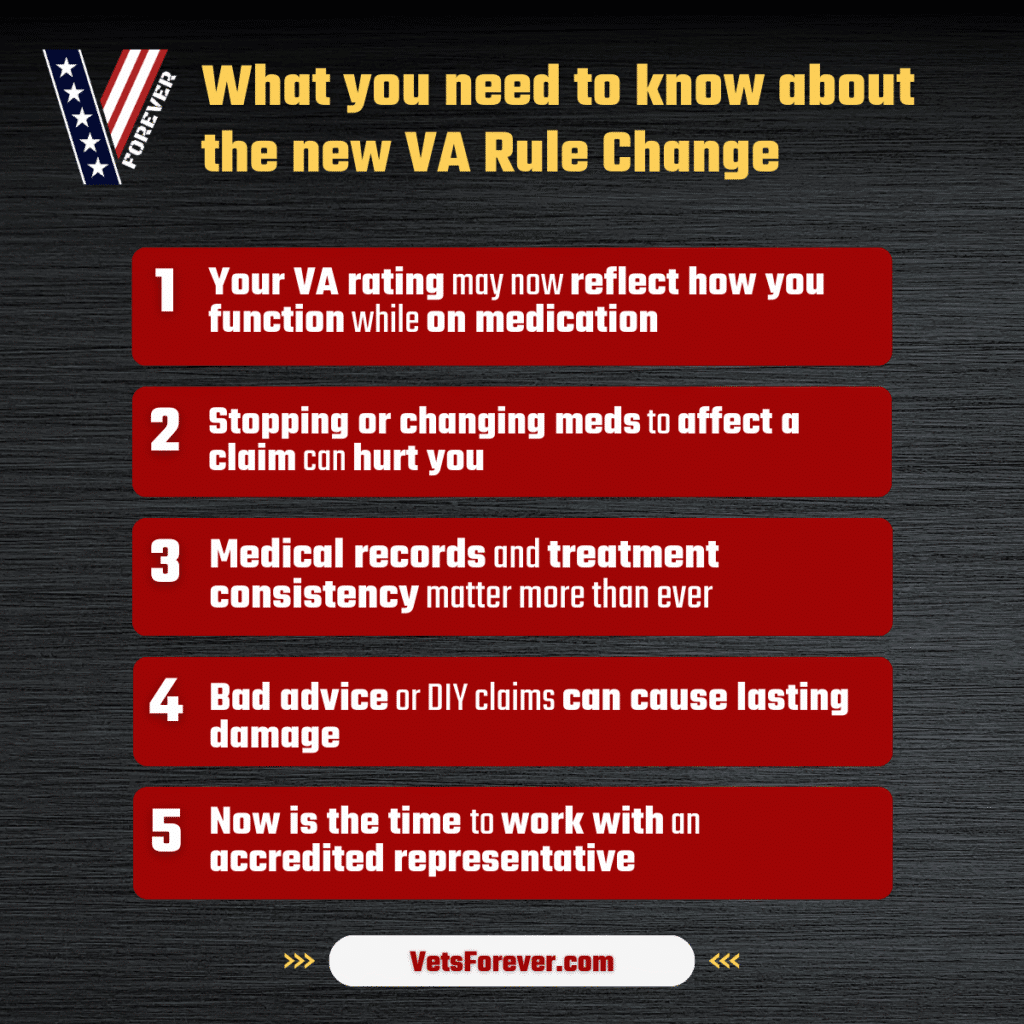
The Real Shift: Functioning With Medication
The core of the new rule centers on how disability severity is evaluated.
What Changed?
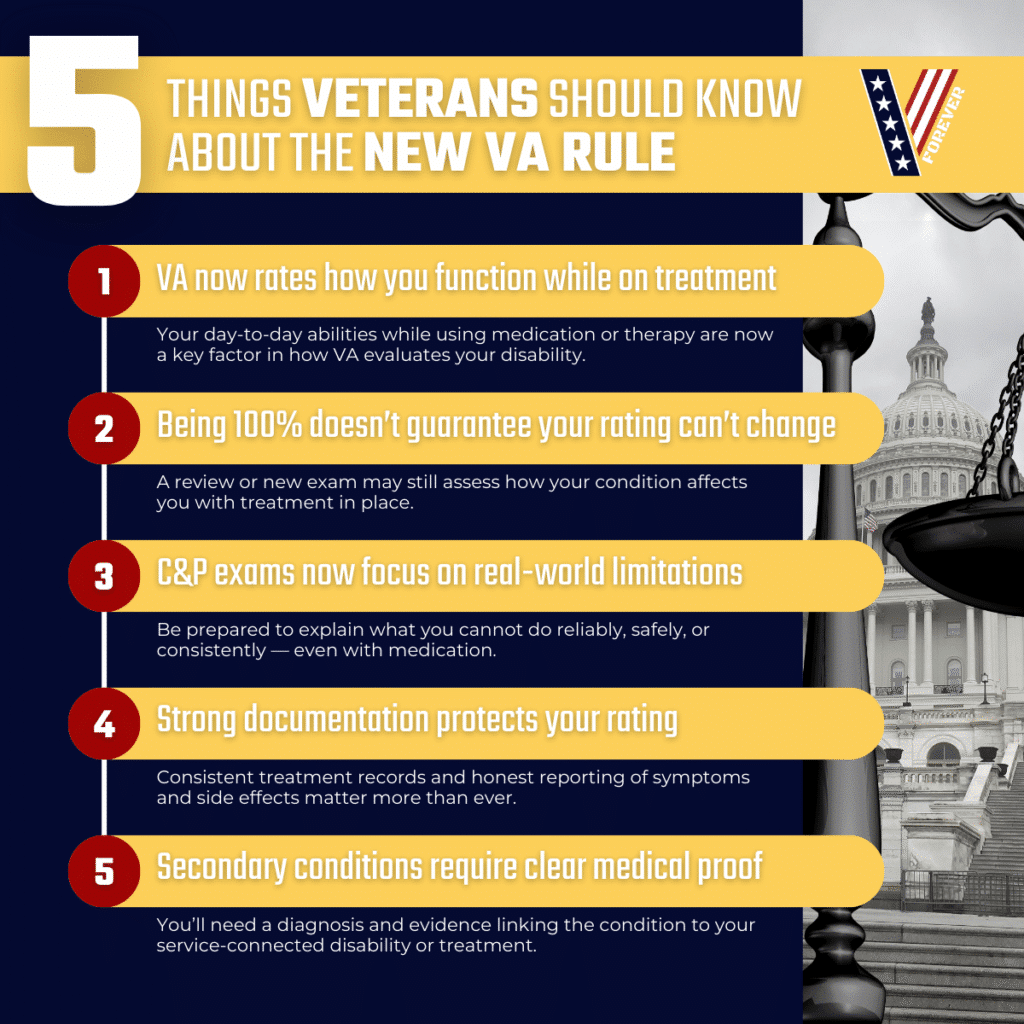
The VA has issued guidance instructing examiners and raters to evaluate disability based on how a veteran functions while receiving treatment, including medication.
That means your day-to-day functioning on meds is now the primary focus when determining your rating.
How Prior Case Law Protected Veterans
Earlier court decisions—often referenced through cases like Jones and Ingram—generally held that the VA could not deny or lower a higher rating simply because medication improved symptoms unless the rating criteria specifically mentioned medication.
Under that framework, the VA was expected to consider the underlying severity of the condition, not just how a veteran presented while medicated on exam day.
The New Standard
The updated rule shifts emphasis:
| Old Approach | New Approach |
| Severity without medication | Functioning with medication |
| Focus on untreated baseline | Focus on treated reality |
| Improvement less relevant | Improvement directly relevant |
If treatment makes a condition appear less impairing in daily life, the VA can now use that medicated level of impairment as the basis for the rating.
Why Representation Matters More Under This Rule
This rule change makes clear that winning claims now requires real representation—not generic coaching or AI paperwork mills.
Under the new framework, successful claims rely on aligning three pillars of evidence:
- Medical documentation
- Legal argumentation
- Functional and occupational impact evidence
Through accredited representation, VetsForever accredited attorney can assist veterans by:
- Reviewing claims files for rating vulnerabilities
- Preparing veterans for C&P exams
- Identifying medication side-effect evidence
- Coordinating independent medical opinions
- Building work and daily-life impairment records
- Challenging improper reductions
This is particularly important when the VA is evaluating functioning on treatment rather than untreated severity.
Medication & C&P Exams: Guidance for Veterans
One harmful myth circulating online is that veterans should stop taking medication before exams.
Do not do this.
Stopping treatment to “look worse” is dangerous and can damage credibility. Instead, veterans should clearly communicate:
- What limitations still exist
- How often symptoms break through treatment
- What side effects medications cause
- How functioning fluctuates
VetsForever advocates often help veterans prepare for these conversations so their real-world impairment is accurately documented.
What If You’re Already Rated 100%?
If you hold a 100% rating, the rule does not automatically trigger a reduction.
However, during any new exams or reviews, the VA will evaluate functioning with treatment.
Risk exposure depends on:
- Length of time at 100%
- Age
- Schedular vs. TDIU ratings
- Static vs. non-static conditions
Accredited review of your file can help determine whether protections apply and how to prepare if exams are scheduled.
The 5-, 10-, and 20-Year Protection Rules
Longstanding safeguards remain in place:
5-Year Rule – Requires sustained improvement for reduction
10-Year Rule – Protects service connection
20-Year Rule – Locks in your rating as a minimum
These protections limit how far the VA can reduce ratings—even under the medication rule.
Understanding where you fall within these timelines is a key part of reduction defense strategy, and something accredited representatives routinely evaluate.
Medication Side Effects as Secondary Conditions
If the VA credits medication improvement to justify a lower rating, veterans should also consider the burden of treatment.
Medication side effects may qualify for secondary service connection.
Examples
- NSAIDs → GERD or ulcers
- Antidepressants → weight gain or sexual dysfunction
- Neuropathic meds → fatigue or cognitive impairment
VetsForever can help veterans:
- Identify secondary claim opportunities
- Gather prescribing records
- Secure nexus opinions
- Document functional impact
This ensures the full picture of disability is represented—not just the treated symptoms.
Appeals & Reduction Defense
Appeal strategy is evolving.
The argument is no longer only:
“VA ignored how severe my condition is.”
It is now often:
“VA ignored how impaired I remain even with treatment.”
Accredited advocates can:
- Challenge weak exams
- Introduce employer evidence
- Submit lay statements
- Obtain medical rebuttals
This integrated legal-medical approach is where accredited representation provides the greatest value.
What Veterans Should Do Right Now
If you’re concerned about the directive:
- Confirm how long you’ve held your rating
- Stay consistent with treatment
- Document daily limitations
- Track medication side effects
- Seek accredited guidance before exams or reductions
Veterans with questions about how this rule may affect their specific case can connect with VetsForever for individualized case reviews.
Final Perspective
The Ingram vs. Collins conversation reflects an evolution in how disability is evaluated—not a blanket rollback of benefits.
Existing ratings are not being automatically stripped. Protections remain intact. Claims and appeals are still being filed and won every day.
What has changed is the evidentiary standard.
Function, not just diagnosis, now drives outcomes.
And in this environment, informed, accredited advocacy—grounded in medical, legal, and occupational evidence—matters more than ever.
For veterans navigating questions, concerns, or next steps, organizations like VetsForever, which is led by a VA-accredited attorney, exist to ensure no one has to interpret policy shifts alone and that every claim is supported with the strategy and representation it deserves.